PTBP Web Desk
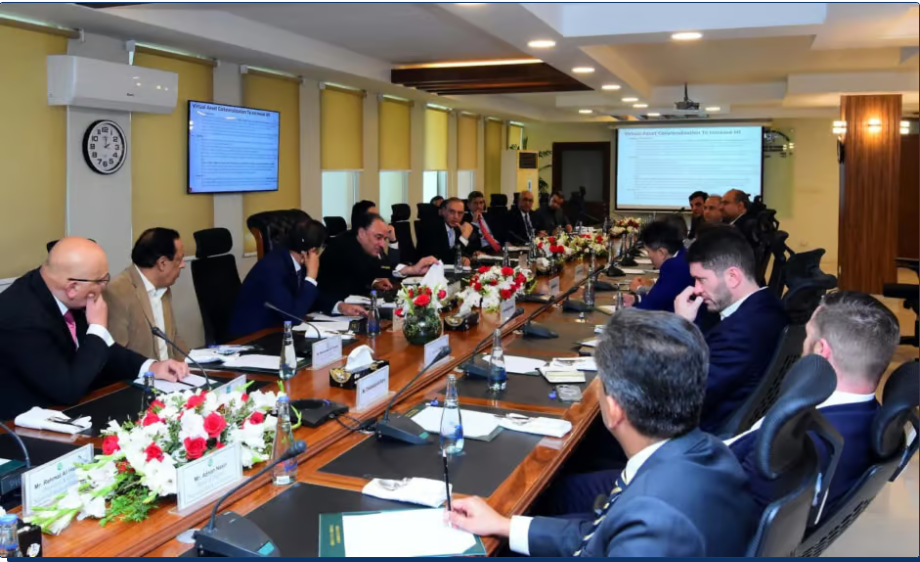
Pakistan has intensified efforts to establish a regulated digital asset ecosystem, marking a significant development after Binance Global CEO Richard Teng arrived in Islamabad for high-level consultations. During a major session held at the Finance Division, top government officials, the State Bank of Pakistan (SBP), leading commercial banks, and Binance leadership held detailed discussions on shaping the country’s National Digital Asset Framework. The meeting signals that Pakistan is moving rapidly toward clearer regulatory rules, enhanced financial transparency, and stronger oversight of the fast-growing virtual asset sector.
The meeting at the Finance Division was co-chaired by Finance Minister Muhammad Aurangzeb and PVARA Chairman Bilal Bin Saqib, with the Binance delegation led by Richard Teng. The objective was to evaluate next steps in building Pakistan’s National Digital Asset Framework, a long-awaited regulatory structure that aims to govern cryptocurrency trading, blockchain innovation, licensing requirements, taxation, and compliance standards.
Government officials reviewed existing institutional gaps and discussed the need for a unified approach that brings together regulators, licensed global exchanges, and Pakistan’s domestic financial sector. This coordination, they agreed, is essential for modernizing Pakistan’s payments infrastructure and ensuring users transition from unregulated platforms to compliant, secure systems.
Finance Minister Aurangzeb emphasized that Pakistan is committed to a forward-looking regulatory model. He noted that while the economy must embrace innovation and blockchain technology, the government must also safeguard national economic stability and protect citizens from risks associated with unregulated crypto activity.
He highlighted that Pakistan’s digital payments system must evolve in line with international standards, especially at a time when digital assets are gaining adoption at a rapid pace. Improved coordination between regulators, licensed exchanges, and the banking industry will help strengthen financial transparency, reduce capital flight, and improve compliance with AML/CFT frameworks.
For context on Pakistan’s previous financial regulatory reforms, readers can visit an internal link such as:
Richard Teng and Binance’s senior leadership briefed the government on global crypto trends, regulatory best practices, and adoption patterns in emerging markets. Teng acknowledged that Pakistan has one of the world’s most active crypto user bases, despite lacking a formal regulatory system.
He explained that by validating and documenting citizen-held virtual assets through regulated channels, Pakistan could strengthen its financial visibility, improve credit risk assessment systems, and align itself with global compliance standards. However, he reiterated that digital assets should not be treated as legal tender, maintaining consistency with IMF and FATF guidelines.
For background on Binance’s global compliance programs, users can visit the external link:
A major part of the discussion focused on transforming Pakistan’s digital payments and remittance ecosystem. Officials emphasized that blockchain-based systems could reduce transaction costs significantly within Pakistan’s USD 38 billion annual remittance flows. Lower fees, faster processing, and higher transparency would benefit millions of overseas Pakistanis and their families.
Participants noted that embracing blockchain technology could also help Pakistan build a strong Web3 and blockchain workforce, creating new opportunities for youth in software development, digital finance, cybersecurity, and decentralized applications.
The meeting also covered innovative concepts such as sovereign debt tokenization, which could allow Pakistan to increase liquidity, broaden investor participation, and position itself as a regional pioneer in blockchain-based financial instruments. Tokenized bonds and government securities are already being tested in various countries, and Pakistan sees an opportunity to become part of this global shift.
Officials conducted a detailed review of regulatory principles needed to build a safe, transparent digital asset environment. Key proposals discussed include:
- shifting oversight and trading activity to licensed exchanges
- developing a gradual capital gains tax (CGT) structure for digital assets
- considering a time-bound amnesty to allow users to shift their holdings to regulated platforms
- building stronger verification, risk monitoring, and compliance systems
These measures would help Pakistan reduce risks linked to money laundering, unregulated offshore platforms, and consumer fraud.
The government and PVARA leadership also reviewed the licensing structure for Virtual Asset Service Providers (VASPs), ensuring that future platforms meet strict transparency and AML/CFT standards while providing Pakistani users with safer alternatives to unregulated exchanges.
Presidents of leading commercial banks participated in the meeting, sharing insights on custody requirements, blockchain integration, and risk management protocols under a future national regulatory framework. Banks stressed that clear rules would enable compliant on-ramps and off-ramps for users, improve investor confidence, and help stabilize the broader financial system.
The Finance Minister noted that a regulated framework would encourage users to transition to licensed exchanges, reducing the risks associated with unregulated offshore crypto activity.
PVARA Chairman Bilal Bin Saqib said Pakistan has a major opportunity to take a leadership role in shaping global digital asset standards. He emphasized that coordinated collaboration between regulators, banks, and exchanges is essential to build a secure, scalable digital asset ecosystem.