PTBP Web Desk
Pakistan is moving ahead with its long-delayed power-sector reforms by inviting international private-sector investors to participate in the planned privatisation of Power Distribution Companies (Discos). The government believes that involvement from global energy players—particularly Turkiye, which has deep experience in managing privatised utilities—will be instrumental in reshaping the country’s struggling distribution framework.
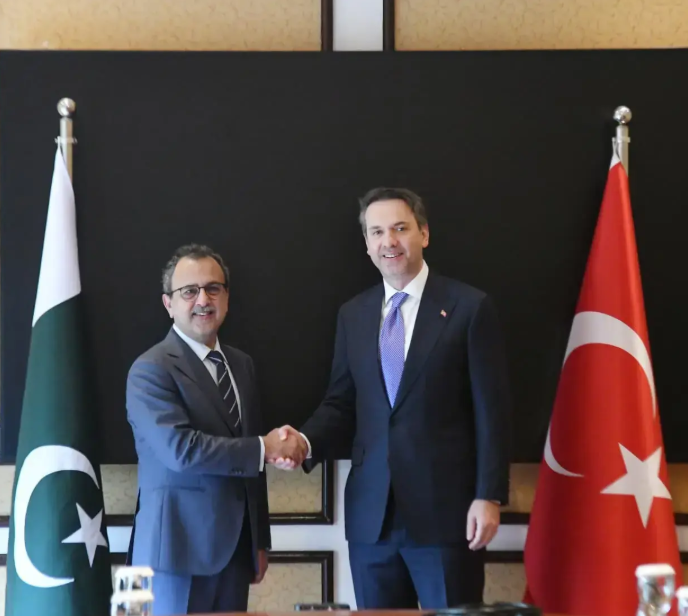
The development was highlighted by Federal Minister for Power Sardar Awais Ahmed Khan Leghari during a meeting with Turkiye’s Minister of Energy and Natural Resources, Alparslan Bayraktar, on Tuesday. The discussion focused on enhancing bilateral cooperation, attracting foreign investment, and learning from Turkiye’s successful transition to a largely privatised and efficient power market.
During the meeting, the federal minister stressed that the government has prepared an Expression of Interest (EOI) for the first three Discos that will be offered to private investors. He emphasised that attracting reputable international players is essential for modernising Pakistan’s power sector, improving distribution efficiency, and reducing chronic losses.
Acknowledging Turkiye’s extensive expertise in power distribution and its effective concession model, the minister said Pakistan places great value on Turkish participation.
“Turkiye’s involvement in the bidding process will be highly significant,” he noted, adding that Pakistan has long admired Turkiye’s ability to successfully run privatised distribution networks with strong performance indicators.
To facilitate knowledge-sharing, he appreciated the Turkish government for providing study opportunities to Pakistani energy experts, enabling them to closely observe Turkiye’s privatised system and its operational strengths.
For background on Pakistan’s broader privatisation programme, readers may refer to the Privatisation Commission’s official website (external link) or earlier reports on power-sector reforms (internal link to your previous article).
The federal minister detailed the ongoing reforms underway within Pakistan’s power sector and shared insights about new investment avenues that may appeal to foreign companies. He underlined that the Power Division is currently preparing an Integrated Energy Plan, an essential long-term framework that will guide the country’s future power generation, distribution, and sustainability efforts.
Given Turkiye’s proven capacity in long-term planning, he urged close collaboration.
He also requested Turkish assistance in human resource development, noting that Pakistan’s power-sector workforce would benefit greatly from training in distribution management, system maintenance, and operational control—areas where Turkiye has demonstrated decades of consistent expertise.
Responding to the invitation, the Turkish Energy Minister appreciated Pakistan’s hospitality and confirmed that Turkish investors are closely monitoring the Disco privatisation process. He expressed optimism that participation from Turkiye would be “substantial” given the scale of the opportunity and the historical economic ties between the two nations.
He highlighted that Turkiye already maintains a notable investment presence in Pakistan, particularly in the mining sector, which is closely linked to energy development.
To support investor mobilisation, the minister agreed to organise roadshows in Turkiye, using the Turkish Investment Forum as a platform to introduce Pakistan’s power-sector opportunities to major players in the Turkish energy market. He assured full cooperation in facilitating meetings, technical exchanges, and investor outreach.
During the meeting, both sides reaffirmed their commitment to deepen cooperation in the power sector, particularly in the areas of regulation, planning, and renewable energy development. Pakistan confirmed it had already shared the composition of several sub-groups created after the 6th Joint Working Group (JWG) meeting held earlier.
These specialised sub-groups will address:
- Regulatory collaboration
- Development of the National Electricity Plan and the Integrated Energy Plan
- Renewable energy areas, including geothermal technologies
- Energy efficiency and conservation initiatives
Turkiye is expected to share its own sub-group structure soon, after which both sides will activate these teams to begin technical discussions. These discussions will later be reported back to the Joint Working Group for policy-level decisions.
Additionally, the meeting recalled the earlier agreement facilitating a technical assistance visit by TEDAS, the Turkish authority responsible for distribution and operations. The visit will focus on maintenance practices, loss reduction strategies, and distribution management techniques that Pakistan seeks to adopt.
Pakistan’s move to privatise Discos marks one of the most significant structural reforms in its energy sector in decades. Chronic line losses, outdated infrastructure, and insufficient investment have long burdened the distribution network. By inviting global players—especially those with proven success in similar markets—the government hopes to introduce competition, improve performance, reduce losses, and deliver more reliable power to consumers.
The focus on Turkiye underscores Pakistan’s desire to replicate the country’s efficient, private-sector-led, concession-based power distribution model as it attempts to reshape a sector that is critical to the nation’s economic recovery.