
PTBP Web Desk
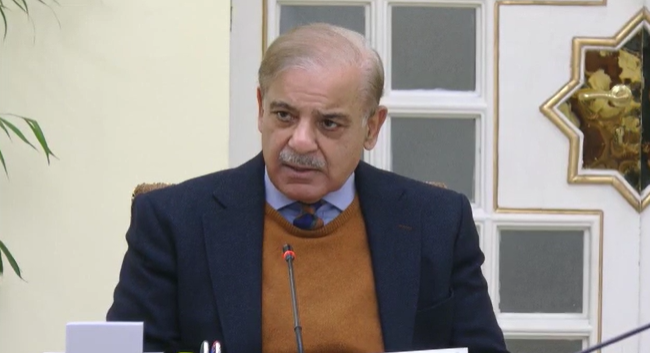
Prime Minister Shehbaz Sharif on Tuesday paid strong tribute to Chief of Army Staff, Field Marshal and Chief of Defence Forces (CDF), Syed Asim Munir, acknowledging his “pivotal” leadership in pushing forward Pakistan’s reform agenda and supporting the country’s economic revival. According to the Prime Minister, Pakistan’s ability to navigate one of the most turbulent financial periods in recent history is closely tied to the stabilizing role played by Gen Munir during a time of deep economic uncertainty.
In his detailed remarks, the Prime Minister stressed that Pakistan’s economic reforms require not only political will but also institutional alignment across all sectors. He noted that Gen Munir’s leadership has been central to maintaining a unified approach within the defence establishment, which, according to Sharif, enabled the government to sustain key reforms without interruption.
Sharif pointed out that Pakistan’s recent progress has not only been recognized internally but has also gained significant international validation. The International Monetary Fund (IMF) recently endorsed Pakistan’s reform policies, calling them essential for restoring macroeconomic stability. This endorsement, the Prime Minister said, serves as a strong external confirmation that the country’s economic path is headed in the right direction. For reference, readers can visit the IMF website for global economic assessments (external link: imf.org).
He further noted that the IMF’s latest disbursement under the Extended Fund Facility demonstrates renewed confidence in Pakistan’s economic reforms. This financial inflow, Sharif emphasized, provides the country with the fiscal breathing room needed to continue implementing long-term structural changes. He highlighted that the endorsement reflects the hard work of the Ministry of Finance and the broader economic team, which has worked to restore credibility and stability.
Reflecting on Pakistan’s economic crisis last year, the Prime Minister acknowledged that the nation had been on the brink of default. He stated that saving Pakistan from collapse required collective sacrifices from political stakeholders, state institutions, and, most importantly, the public. Through coordinated efforts, Pakistan managed to pull itself back from the edge, a recovery the Prime Minister described as “turning the impossible into reality.”
Sharif expressed confidence that Pakistan is now entering a new phase of economic direction, driven by reforms targeting fiscal discipline, technological innovation, and the digital transformation of government services. He highlighted initiatives under the government’s digitalisation program, supported by key departments such as the Pakistan Digital Authority (internal link suggestion: cabinet.gov.pk, finance.gov.pk), which are laying the foundation for a more transparent and efficient governance system.
He stated that the continuation of reforms not only boosts investor confidence but also strengthens the country’s standing in the global financial system. Pakistan’s economic resilience, according to the Prime Minister, is increasingly visible to the international community, which has started acknowledging the impact of ongoing structural reforms.
Prime Minister Sharif added that the steady recovery observed in Pakistan’s key macroeconomic indicators—such as inflation management, revenue improvement, and fiscal consolidation—is closely linked to institutional reforms initiated under the government’s economic framework. He reiterated that completing these reforms is essential to eliminating Pakistan’s dependency on foreign loans in the long term.
Addressing the nation’s aspirations, Sharif stated that Pakistan is striving toward sustainable economic independence. “The day is not far off when Pakistan will stand free from the burden of external debts,” he remarked. He reaffirmed his government’s commitment to securing a future in which the economy stands strong, diversified, and self-reliant.
Highlighting Gen Asim Munir once again, the Prime Minister praised his role in strengthening Pakistan’s internal cohesion at a time when economic pressures could have destabilized national confidence. He said that Munir’s stabilizing presence in the military leadership played a vital role in reinforcing the national resolve to undertake bold reforms despite political and economic challenges.
Sharif added that Pakistan’s successful implementation of these reforms has become a case study for other developing nations facing similar crises. “Our journey has already inspired others, and soon Pakistan’s dream of sustainable economic growth will be realised,” he said.
Concluding his remarks, the Prime Minister pledged that his government would continue to push forward with unwavering dedication. He reaffirmed that economic independence is the ultimate goal and that no effort will be spared in achieving it. “As the servant of Pakistan, my commitment to the well-being of our people is absolute,” he said. “I will not rest until we break free from the shackles of external debt and secure a prosperous future for this nation.”