PTBP Web Desk
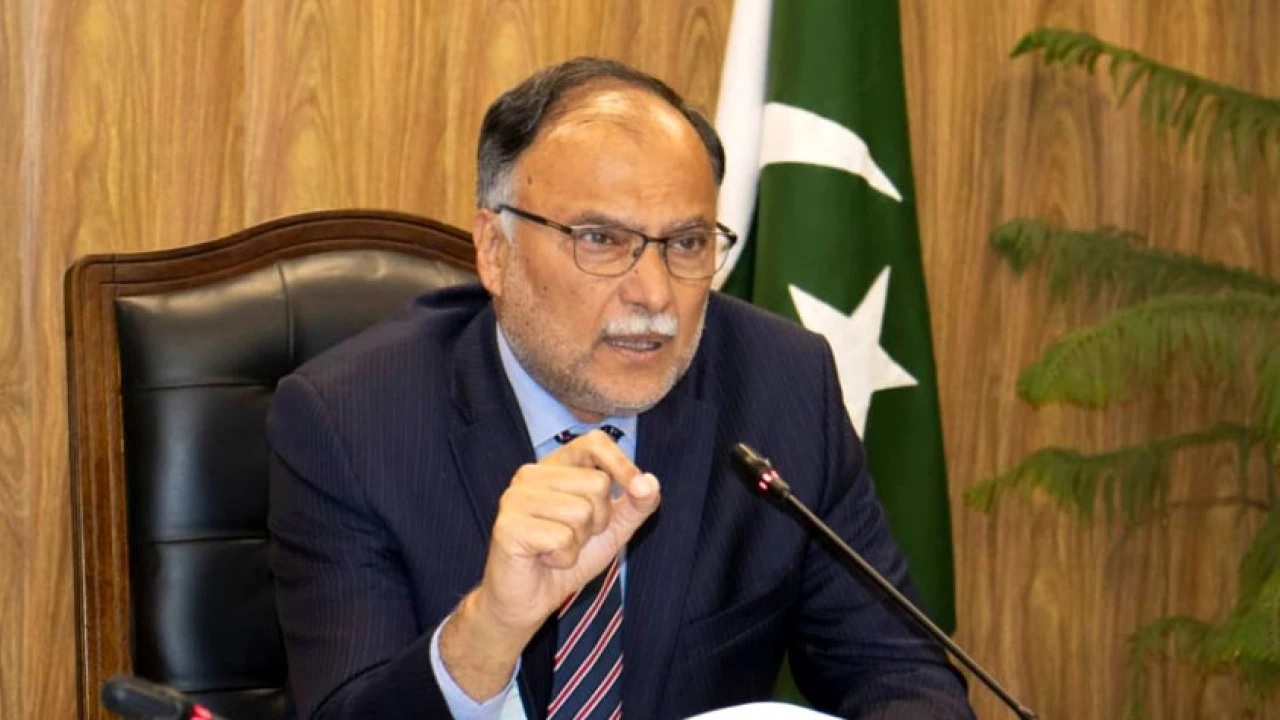
Planning Minister Ahsan Iqbal on Friday strongly defended Pakistan’s decision to join the Board of Peace, rejecting criticism from opposition parties and asserting that Islamabad’s participation enhances diplomatic efforts to support peace in Gaza and the wider Muslim world. His remarks came in response to sharp objections raised by Jamiat Ulema-e-Islam (F) chief Maulana Fazlur Rehman, who questioned the legitimacy and process behind joining the US-backed forum.
Pakistan formally accepted US President Donald Trump’s invitation to become part of the Board of Peace, a newly formed international mechanism intended to support the implementation of the Gaza Peace Plan. The charter of the forum was signed in Davos, on the sidelines of the World Economic Forum, a day earlier. While the Foreign Office has not yet disclosed full operational details, officials have indicated that the forum will focus on facilitating ceasefire arrangements, coordinating humanitarian aid, and supporting post-conflict reconstruction, in line with broader efforts under United Nations auspices.
Addressing the National Assembly, Ahsan Iqbal reiterated Pakistan’s long-standing and principled position on Israel, making it clear that participation in the Board of Peace does not signal any policy shift.
“Israel is a brutal country, and there is no change in this principled stance,” Iqbal said. “Pakistan has set an example of independence and sovereignty. The United States made five calls to prevent nuclear explosions, yet we decided with courage, despite the entire world. We are the guardians of Pakistan’s security and sovereignty.”
His remarks were aimed at countering opposition claims that Pakistan’s foreign policy decisions are influenced by external pressure. Iqbal emphasized that Pakistan has historically taken bold decisions in defense of its national interests and continues to do so today.
The planning minister argued that Pakistan’s engagement with the Board of Peace is motivated by humanitarian concerns and diplomatic responsibility. Referring to the humanitarian catastrophe in Gaza, he said Pakistan’s “hearts are torn” by the suffering of Palestinians and stressed that Islamabad could not afford to remain isolated during such a critical moment.
“If Pakistan had not participated in the Board of Peace, they would have said Pakistan stood alone,” he noted. “By joining, we are standing with other Muslim nations to support peace, not just in Gaza but across the Muslim world.”
He pointed out that several influential Muslim countries — including Saudi Arabia, Turkey, Qatar, Bahrain, and the United Arab Emirates — are also part of the initiative. According to Iqbal, Pakistan’s presence alongside these allies strengthens collective diplomatic efforts rather than weakening them.
Ahsan Iqbal described Pakistan’s role in the Board of Peace as a diplomatic success, arguing that Islamabad now has a seat at a platform where future humanitarian and reconstruction efforts will be coordinated.
“Saudi Arabia, Turkey, Bahrain, and the UAE are not only Muslim nations but also Pakistan’s closest allies,” he said. “This gives Pakistan a chance to contribute meaningfully to peace initiatives across the Muslim world.”
He added that meaningful diplomacy requires engagement, not withdrawal, and that Pakistan’s absence from international forums would only allow others to shape outcomes without its input.
The decision to join the Board of Peace has sparked significant political controversy. During Thursday’s National Assembly session, Maulana Fazlur Rehman strongly criticized the government for associating with the forum without consulting parliament.
He argued that the board had been created unilaterally by President Trump and questioned its credibility, saying: “If we associate hopes of peace, economic stability, and a better future for Palestinians with such a board, it would be nothing but deceiving ourselves.”
The JUI-F chief also accused the government of abandoning Pakistan’s independent foreign policy tradition. Recalling Quaid-e-Azam Muhammad Ali Jinnah’s stance, he reminded lawmakers that Jinnah had described Israel as an “illegitimate state” and questioned whether current rulers were still adhering to that position.
Maulana Fazlur Rehman further questioned whether the National Assembly had been taken into confidence before the decision was made.
“You are supposed to represent 250 million people there. Did you even consider taking this House into confidence for a moment?” he asked, adding that although he did not view the assembly as a true representative body, it nonetheless claimed that status.
Calling the matter serious, he said parliament was being sidelined and effectively rendered irrelevant. He also questioned whether the decision had been discussed in the federal cabinet, describing it as the government’s executive authority. “Even the cabinet was not taken into confidence,” he claimed.
The Pakistan Tehreek-e-Insaf (PTI) joined JUI-F in rejecting the government’s decision, calling it a matter of international importance that should have been handled with transparency and consensus.
In a statement issued on X (formerly Twitter), the PTI said it did not accept the decision and stressed that “decisions of such international significance must always be undertaken with full transparency and inclusive consultation with all major political stakeholders.”
The party warned that unilateral decisions in sensitive foreign policy matters could weaken national unity and undermine Pakistan’s position on the global stage.
Government officials, however, have repeatedly insisted that the decision to join the Board of Peace was made through constitutional and institutional processes, with approval at the highest political level. They argue that Pakistan’s participation is purely diplomatic and humanitarian, and does not involve any military or security commitments.
They also reject the narrative that joining the forum compromises Pakistan’s support for Palestine, emphasizing that Islamabad’s position on a two-state solution, with Jerusalem (Al-Quds Al-Sharif) as the capital of an independent Palestinian state, remains unchanged.